
Spring brings warmer days to the Four States, but for allergy sufferers in Joplin, Webb City, Carl Junction, and beyond, it also brings sneezing, congestion, and itchy eyes. While you cannot control what is in the outdoor air, you can control what you breathe inside, and your HVAC system is one of the most effective tools for doing exactly that. Harris Heating & Air is here to help you make the most of it.
Spring Air Quality in Joplin, Webb City, and the Four States
The Four States region experiences high levels of tree, grass, and ragweed pollen every spring. According to the CDC, pollen exposure can trigger inflammation of the nasal passages, allergic rhinosinusitis, and headaches. As temperatures rise and windows open, outdoor pollen accumulates indoors without proper filtration. For Joplin, Webb City, Carl Junction, and Pittsburg residents, a professionally maintained HVAC system is not optional—it is essential.
How Local Pollen and Humidity Tank Your Indoor Air Quality
Pollen is only part of the problem. Spring in the Four States also brings rapid swings in indoor humidity that aggravate spring allergies. The EPA recommends maintaining indoor relative humidity between 30 and 50 percent to limit mold and biological contaminant growth. Above that range, conditions favor the growth of dust mites, mold spores, and other allergens. To manage both threats, the CDC advises keeping windows closed during peak pollen season and relying on your HVAC system to filter and circulate indoor air.
How Your HVAC System Directly Affects Air Quality at Home
Your HVAC system does more than regulate temperature. The EPA identifies HVAC systems as the primary mechanism for ventilation and filtration in homes and commercial buildings. A neglected system, however, can work against you—contaminating ductwork and air handlers can harbor mold and distribute biological contaminants throughout your entire space. Scheduling a seasonal tune-up ensures your system is filtering effectively rather than recirculating the very allergens you are trying to avoid.
Air Filters and Air Quality: Does a MERV Rating Matter?
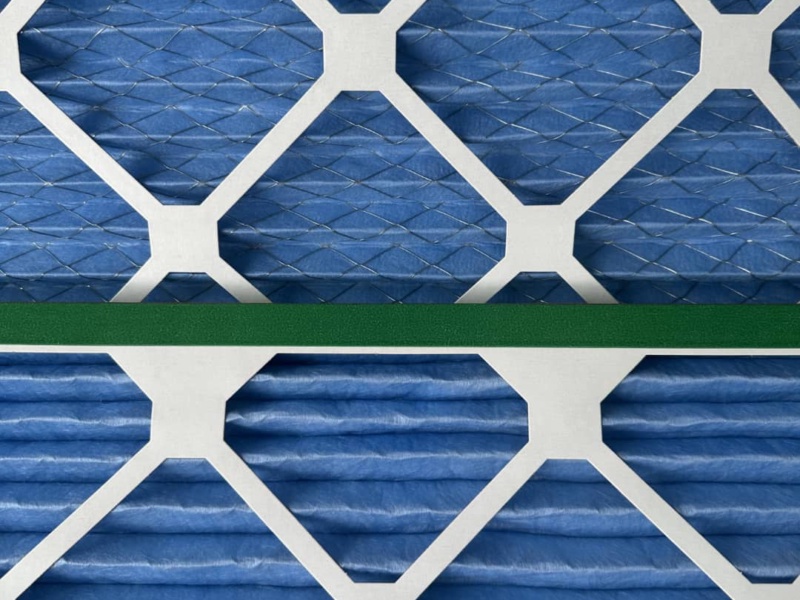
Yes—significantly. MERV, which stands for Minimum Efficiency Reporting Value, is the standard rating system that measures how effectively an HVAC filter captures airborne particles. Specifically, it rates a filter's ability to capture particles between 0.3 and 10 microns in size, including pollen, mold spores, and pet dander.
To understand why that matters, it helps to put microns in perspective. A micron is a unit of measurement invisible to the naked eye. For example, a single human hair averages about 70 microns in diameter—not its length, but its width across. Conversely, the period at the end of this sentence measures approximately 400-615 microns across, depending on the font and preferences. An unfiltered home or business can contain 289 to 600 airborne particles per cubic inch at 0.5 microns or larger, and that count climbs sharply as particle size decreases. To put the scale of those particles in context:
- Pollen grains measure between 10 and 100 microns.
- Mold spores range from 1 to 20 microns.
- Pet dander is as small as 0.5 microns.
Both a human hair and a printed period are enormous compared to what a MERV filter is designed to capture. A MERV 13 filter targets particles down to 0.3 microns—roughly 230 times smaller than an average human hair and over 1,300 times smaller than a printed period. The smaller the particle, the deeper it can travel into the lungs, which is why a higher-rated filter offers better protection than a standard one.
Both the EPA and the American Lung Association recommend a minimum MERV 13 rating for allergy reduction. Filters rated MERV 13 or higher must demonstrate at least 50% removal efficiency for the smallest particles tested.
Key HVAC filter facts:
- MERV ratings range from 1 to 16—the higher the number, the finer particles get filtered out of the air before entering your home or business.
- A MERV 13 filter captures pollen, mold spores, and fine dust particles.
- Replace filters every 60–90 days during the spring allergy season.
- The wrong filter size reduces effectiveness and strains your system.
- Confirm your HVAC unit can accommodate a higher MERV rating before upgrading.
HVAC Add-Ons That Improve Home Air Quality This Spring
A properly rated HVAC filter is the foundation, but it does not have to work alone. Beyond a standard HVAC filter, these targeted add-ons can further reduce allergen levels throughout your home or business:
- Whole-home dehumidifiers maintain indoor humidity within the EPA-recommended 30–50% range.
- High-efficiency media filters rated MERV 13 capture finer particles than standard 1-inch filters.
- UV germicidal lights (UVGI) installed inside the air handler target airborne microorganisms.
- A portable air purifier for allergies supplements your central system in bedrooms and high-use rooms.
- Professional duct cleaning removes accumulated pollen and debris before it recirculates.
Schedule Your Spring HVAC Service With Harris Heating & Air
If you own a home or operate a business in Joplin, Webb City, Carthage, Carl Junction, or Neosho, now is the time to act. Spring pollen season moves fast, and a seasonal HVAC inspection from Harris Heating & Air delivers the filtration, humidity control, and system performance your space needs to stay comfortable and healthy all season long. Call Harris Heating & Air in Webb City, Missouri, today at 417-310-0132 to schedule your spring tune-up or HVAC repair, and stop letting pollen control your comfort.